Ethereum networks at casinos: mainnet, Arbitrum, Base and what happens if you slip
The networks
Your 0x address is the same on Ethereum, Arbitrum, Base and Optimism. The casino is not: it credits only the networks its cashier names. Here is how to tell them apart, what the casinos we read accept, and what to do when the deposit has left on the wrong network.
Ethereum networks are the reason an ETH deposit can fail to arrive even when the address is right. Ethereum, the main network that cashiers also call mainnet or ERC-20, is not the only place ETH lives. There are the second-layer networks, the L2s such as Arbitrum, Optimism and Base, and there are other compatible networks, such as BNB Smart Chain, that use the same address format. Your wallet shows one address for all of them. The casino watches only the ones it has chosen to follow.
Why the address is the same on several networks
A 0x address comes out of a private key, and the same key opens the same address on every Ethereum-compatible network. That is why MetaMask shows you an identical 0x… when you switch from Ethereum to Arbitrum. The casino’s deposit address works the same way: it exists on all of those networks. But the casino watches transactions only on the networks it has wired into its cashier, and credits a balance only on those.
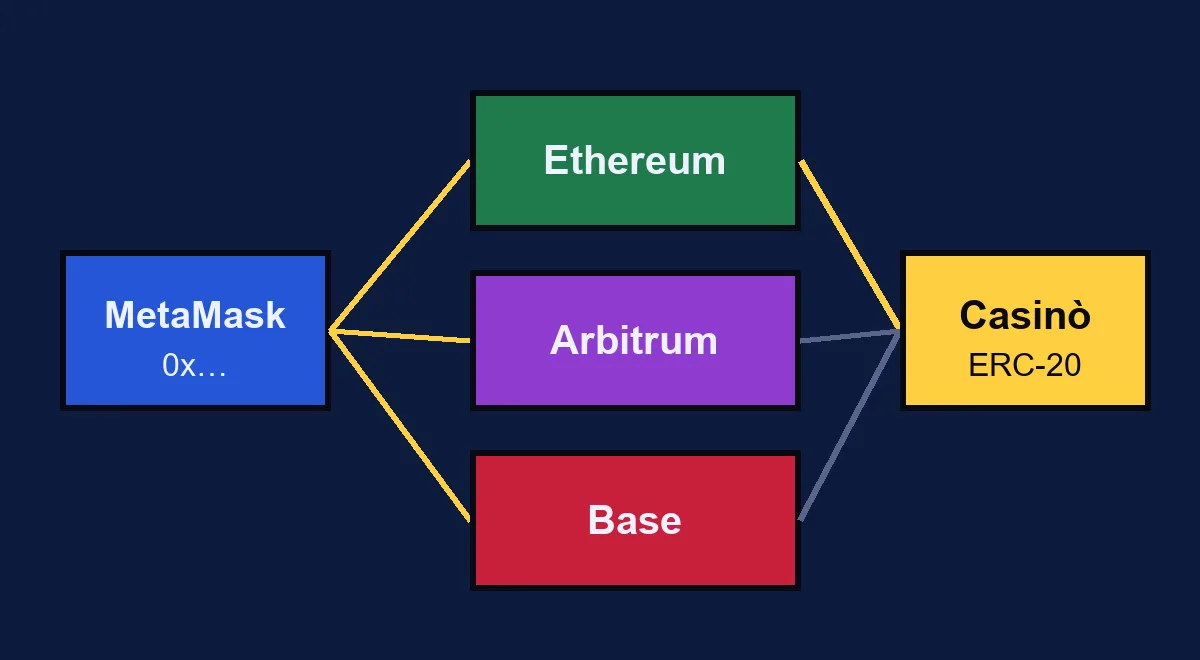
The practical upshot is that the wallet will not stop you. If MetaMask is set to Arbitrum and you paste the casino’s address, the send goes out, confirms, and appears on Arbiscan. The casino, if it follows Ethereum alone, sees nothing at all.

The networks you meet in cashiers
- Ethereum (mainnet, ERC-20). The main network. It is the one nearly every casino takes for ETH, and the dearest to use.
- Arbitrum and Optimism. Two L2s that write to Ethereum in batches. Same ETH, far lower gas. We rarely found them in casino cashiers for ETH.
- Base. An L2 from the same family as Optimism. Shuffle takes it for both ETH and USDC.
- BNB Smart Chain (BEP-20). Not Ethereum, but it uses 0x addresses. The ETH you find there is a version bridged onto that network.
- Polygon. An Ethereum-compatible network; in cashiers you meet it mostly for USDT and USDC.
What the casinos we read accept
We read the help centres of the twelve casinos in our ranking of Ethereum casinos on 18 September 2026. Only four, counting Vave, say in a readable page which network the ETH arrives on:
| Casino | ETH | USDT | USDC |
|---|---|---|---|
| Vave | Ethereum | ERC-20, TRC-20, Solana | not stated |
| Wild.io | Ethereum only (ERC-20) | ERC-20, TRC-20, BEP-20 | ERC-20 |
| Shuffle | Ethereum, BEP-20, Base, Robinhood Chain | ERC-20, BEP-20, TRC-20, Polygon, Solana | ERC-20, BEP-20, Solana, Polygon, Base, Arbitrum |
| Rocketpot | Ethereum; no Arbitrum, Base, Polygon | ERC-20, TRC-20 | ERC-20 |
The other eight do not say so in any page our server could open. That does not mean they fail to write it in the cashier: it means you will find it there, under the deposit address, and that is where you have to look anyway.
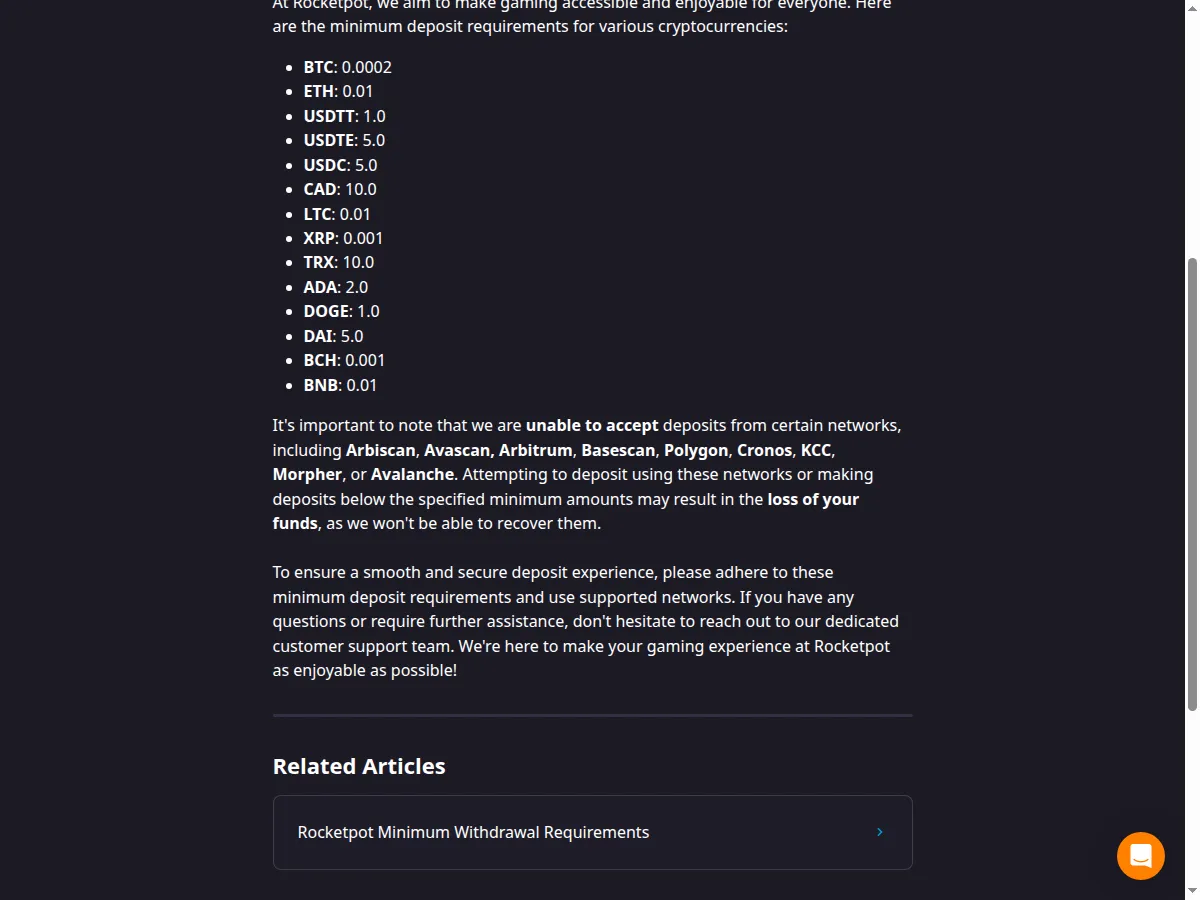
The Rocketpot example: the excluded networks
Rocketpot is the only one of the twelve that lists the networks it will not take: Arbitrum, Avalanche, Base, Polygon, Cronos, KCC and others. On the same page it writes that depositing from one of those, or below the minimum, can cost you the funds. It is the most useful sentence we found in the whole search, because it says exactly what happens in the worst case, without dressing it up.
The Shuffle example: more networks, more choice, more care
Shuffle goes the other way. For ETH it takes four networks, for USDC six. For anyone holding ETH on Base that is convenient: gas is a fraction of the main network’s. But more networks also means more chances to pick the wrong one in the menu. On the same page Shuffle warns against depositing stablecoins on unsupported networks, and even names the USDC contract on Arbitrum that it accepts. If you hold USDC on Arbitrum, compare that contract with the one in your wallet.
If you picked the wrong network
- Do not send more money “to test it”.
- Find the transaction on the explorer of the network you used (Etherscan, Arbiscan, Basescan) and copy the hash.
- Write to the casino’s support with the hash, the amount, the network and the time.
- Ask whether they can recover it, and on what terms.
Recovery depends on the casino: technically the address exists on the other network too, but not every casino controls the key on every network, and not every casino agrees to try. Rocketpot rules it out in writing. That is why the first deposit at a new casino should be small. The step-by-step is in MetaMask and casinos.
Network and cost travel together
Choosing the network also means choosing how much you pay. On the main network a plain ETH send uses 21,000 units of gas, and the gas price shifts minute by minute; on the L2s the same send costs far less. But an L2 is only worth it if the casino takes it. The arithmetic in euros, with an example to redo with the day’s figures, is in gas and fees. For stablecoins, where there are more networks still, there is the page on USDT ERC-20.
In short
The cashier gives the order, the wallet carries it out. Read the network under the deposit address, select it in the wallet, check again before you confirm, and make the first send a small one. If the cashier says only “ETH”, it means the main network. If you want to use an L2, look for a casino that names it, the way Shuffle names Base. And play only with what you can afford to lose: no network changes the house edge.